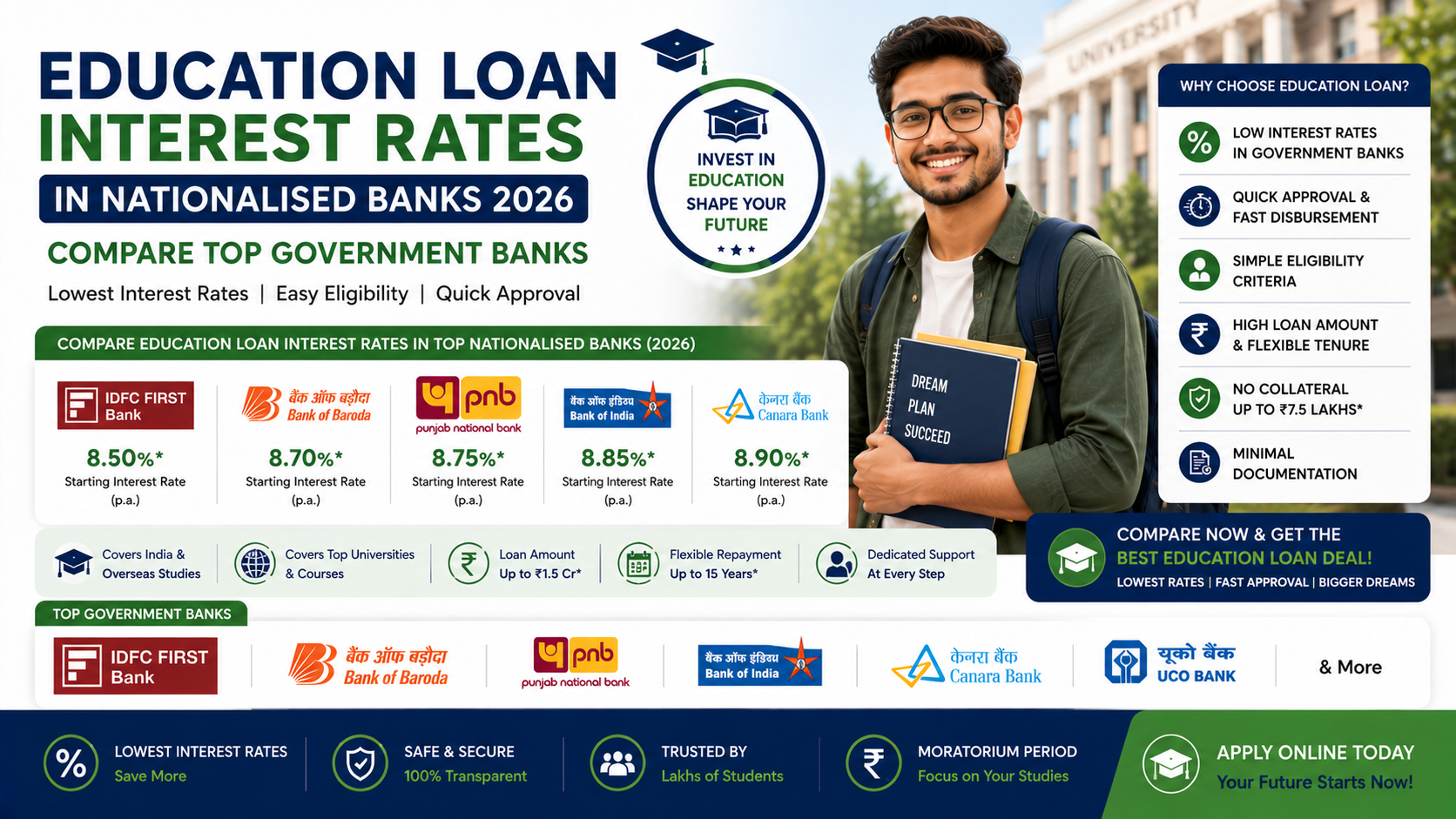
Education Loan Interest Rates in Nationalised Banks (2026): Compare Top Government Banks
Higher education is becoming increasingly expensive, making education loans an essential financial tool for many students and families. If you’re looking for affordable financing, understanding Education Loan Interest Rates in Nationalised Banks can help you choose a lender that fits your academic goals and financial situation.
Government-owned banks are among the most trusted education loan providers in India. They often offer competitive interest rates, flexible repayment options, longer loan tenures, and financing for studies in India as well as abroad. However, the final interest rate and loan terms depend on several factors, including the student’s course, institution, loan amount, and the co-applicant’s financial profile.
In this guide, we’ll explain how education loan interest rates work, compare leading nationalised banks, discuss eligibility, required documents, and provide practical tips to improve your chances of loan approval.
Why Choose a Nationalised Bank for an Education Loan?
Nationalised banks have been a preferred choice for education financing due to their extensive branch network and student-friendly loan products.
Some key benefits include:
Competitive Interest Rates
Government banks generally offer education loans with competitive interest rates compared to many private lenders.
Flexible Repayment Options
Most nationalised banks provide repayment after course completion along with an applicable moratorium period.
Higher Loan Amounts
Eligible students can obtain funding for undergraduate, postgraduate, professional, technical, and overseas education.
Transparent Loan Terms
Government banks follow structured lending policies, making loan conditions more transparent for borrowers.
Wide Acceptance
Most nationalised banks finance students admitted to recognized institutions in India and abroad, subject to their lending policies.
Education Loan Interest Rates in Nationalised Banks
Education Loan Interest Rates are not identical across all government banks. Each bank evaluates applications based on its own credit policies.
The final interest rate depends on:
- Course selected
- Educational institution
- Loan amount
- Co-applicant’s income
- Credit profile
- Repayment capacity
- Loan tenure
Rather than choosing a lender solely based on the advertised interest rate, compare processing fees, repayment flexibility, moratorium benefits, and customer service.
Top Nationalised Banks Offering Education Loans
Several government-owned banks provide education loans across India.
Popular options include:
- State Bank of India (SBI)
- Punjab National Bank (PNB)
- Bank of Baroda
- Canara Bank
- Union Bank of India
- Indian Bank
- Bank of India
- UCO Bank
- Central Bank of India
- Punjab & Sind Bank
Each bank has different eligibility criteria, maximum loan amounts, approved institutions, and repayment terms. Comparing multiple lenders helps you choose the most suitable option.
Education Loan Eligibility
Although eligibility varies across banks, most nationalised banks consider the following:
- Indian citizen
- Admission to a recognized educational institution
- Eligible undergraduate, postgraduate, or professional course
- Satisfactory academic performance
- Co-applicant with stable income (where required)
- Adequate repayment capacity
- Compliance with bank-specific guidelines
Meeting these conditions can improve approval chances.
Documents Required
Preparing all required documents before applying helps avoid delays.
Student Documents
- Aadhaar Card
- PAN Card (if applicable)
- Passport (for overseas education)
- Admission Letter
- Academic Mark Sheets
- Entrance Exam Scorecards (if applicable)
- Course Fee Structure
Co-Applicant Documents
- PAN Card
- Aadhaar Card
- Salary Slips or Business Income Proof
- Bank Statements
- Income Tax Returns (where applicable)
Additional Documents
- Passport-size photographs
- Address Proof
- Collateral documents (if applicable)
Banks may request additional documents depending on the loan amount and course.
Education Loan for Studies in India & Abroad
Nationalised banks finance a wide range of educational programs.
Study in India
Loans generally cover:
- Tuition fees
- Hostel expenses
- Examination fees
- Books
- Equipment
- Other approved academic expenses
Study Abroad
Education loans for overseas studies may also cover:
- Tuition fees
- Travel expenses
- Visa charges
- Accommodation
- Insurance
- Other approved educational costs
Coverage depends on the lender’s policies.
How to Get the Best Education Loan Interest Rate
Before applying, consider these tips:
Maintain Strong Academic Performance
Good academic records improve lender confidence.
Choose a Recognized Institution
Admission to an approved institution strengthens your application.
Select a Financially Stable Co-Applicant
Banks carefully evaluate the co-applicant’s repayment capacity.
Compare Multiple Nationalised Banks
Different banks offer different repayment options, processing fees, and loan features.
Submit Complete Documentation
Accurate documentation speeds up approval and reduces the chances of rejection.
Common Reasons for Education Loan Rejection
Applications may be rejected due to:
- Incomplete documentation
- Weak co-applicant financial profile
- Poor credit history of the co-applicant
- Admission to an unapproved institution
- Ineligible course
- Incorrect application details
Preparing your application carefully can significantly improve approval chances.
Why Choose Hexafin Loan Consultancy?
Comparing multiple government banks individually can be time-consuming.
At Hexafin Loan Consultancy, we help students and parents compare Education Loan options from leading nationalised banks and NBFCs based on their academic profile and financial requirements.
Our services include:
- Free education loan eligibility assessment
- Comparison of multiple lenders
- Documentation assistance
- Faster application processing
- Guidance for domestic and overseas education loans
- End-to-end support until loan disbursal
Instead of approaching several banks individually, we help you identify lenders where your approval chances are strongest.
Planning Your Higher Education?
Let Hexafin Loan Consultancy help you find the right education loan.
Why Students Trust Hexafin
- ✔ Free Loan Eligibility Check
- ✔ Compare Leading Nationalised Banks
- ✔ Competitive Interest Rate Options
- ✔ Documentation Support
- ✔ Faster Processing
- ✔ Expert Guidance Throughout the Process
Book Your FREE Education Loan Consultation Today and take the next step toward achieving your educational dreams.
Frequently Asked Questions
1. Which nationalised bank offers the best education loan?
The best bank depends on factors such as your course, institution, loan amount, repayment capacity, and the bank’s lending policy. Comparing multiple banks is recommended.
2. Can I get an education loan without collateral?
Some nationalised banks offer unsecured education loans for eligible students, depending on the loan amount, institution, and co-applicant profile.
3. Does the co-applicant’s income affect approval?
Yes. Most government banks evaluate the co-applicant’s income and repayment capacity before sanctioning the loan.
4. Can I apply for an education loan to study abroad?
Yes. Most leading nationalised banks finance eligible students pursuing approved courses at recognized international institutions.
Conclusion
Choosing the right lender is essential when comparing Education Loan Interest Rates in Nationalised Banks. While interest rates are important, borrowers should also evaluate repayment flexibility, processing fees, approved institutions, loan coverage, and customer support before making a decision.
A strong academic record, complete documentation, and a financially stable co-applicant can significantly improve your chances of approval. If you need expert assistance, Hexafin Loan Consultancy can help you compare education loan options from leading government banks and NBFCs, assess your eligibility, and guide you through the complete loan process—making higher education more accessible and financially manageable.